| MOQ: | 1PCS |
| Price: | USD9.99-99.99 |
| Standard Packaging: | Vacuum bags+Cartons |
| Delivery Period: | 8-9 working days |
| Payment Method: | T/T |
| Supply Capacity: | 5000PCS per month |
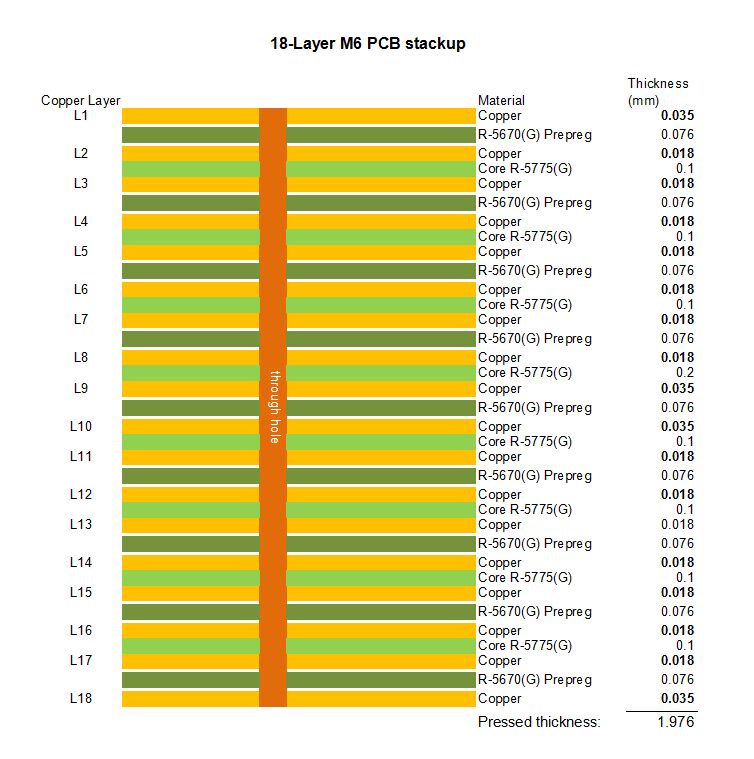
This 18-layer high-speed PCB is built with Panasonic Megtron6 laminate, featuring a glass transition temperature (TG) of 185°C and an overall thickness of 2.013mm. Both inner and outer layers adopt a uniform 35μm copper thickness, paired with a matte green solder mask and white silkscreen. The surface finish is chemical gold immersion, with a gold thickness of 2μm covering 29% of the board area. Measuring 240mm × 115mm per unit, this PCB incorporates additional PP sheets and integrates key processes such as one cycle of through-hole resin filling with copper capping, serial number marking, and yin-yang copper design, alongside mandatory impedance and low-resistance testing. The Megtron6 laminate delivers exceptional electrical performance for high-speed signal transmission, satisfying the rigorous demands of high-frequency, high-reliability electronic systems.
PCB Specifications
| Construction Parameter | Specification |
| Base Material | Panasonic Megtron6 (R5775G, HVLP) laminate (TG 185°C) with additional PP sheets |
| Layer Configuration | 18-layer high-speed PCB |
| Board Dimensions | 240mm × 115mm per unit, 1PCS |
| Total Thickness | 2.013mm (precision controlled) |
| Copper Thickness | Inner & outer layers: 35μm (uniform thickness across all layers) |
| Surface Finish | Chemical Gold Immersion: 2μm gold thickness, 29% of the board area covered |
| Solder Mask & Silkscreen | Solder mask: Matte green; Silkscreen: White |
| Key Processes | Through-hole resin filling & copper capping; Serial number marking; Yin-yang copper design |
| Testing Requirements | Impedance testing; Low-resistance testing |
Panasonic Megtron6 Laminate
Panasonic Megtron6 (model R5775G, HVLP) is a high-performance low-loss laminate engineered for next-generation high-speed PCBs, specifically developed to resolve signal integrity challenges in high-frequency systems. Its core characteristics and advantages are as follows:
-Superior Electrical Performance: Possesses ultra-low dielectric loss (Df) and a stable dielectric constant (Dk) over a broad frequency spectrum, effectively reducing signal attenuation and crosstalk—an essential attribute for high-speed signal transmission exceeding 10Gbps.
-Enhanced Thermal Stability: With a TG of 185°C, it offers excellent heat resistance and dimensional stability during high-temperature manufacturing processes (e.g., soldering, lamination) and under harsh operating conditions, ensuring long-term operational reliability.
-HVLP Design: The HVLP (Highly Volatile Low Profile) feature reduces volatile components, mitigating void formation during lamination and enhancing interlayer bonding quality—critical for 18-layer high-density PCB designs.
-Broad Process Compatibility: Compatible with standard PCB manufacturing workflows, including chemical gold immersion, resin filling, and impedance control, enabling mass production while upholding consistent performance.
-Strong Environmental Adaptability: Low water absorption and outstanding humidity resistance boost stability in complex operating environments, making it suitable for high-reliability applications.
![]()
What is a High-Speed PCB?
A high-speed PCB refers to a printed circuit board designed to transmit signals at high frequencies (typically above 100MHz or with signal rise/fall times under 1ns) while preserving signal integrity. Unlike conventional PCBs, high-speed PCBs prioritize minimizing signal degradation factors—such as crosstalk, reflection, attenuation, and electromagnetic interference (EMI)—which become more pronounced as signal speed increases.
Key design elements for high-speed PCBs include controlled impedance (to match signal sources and loads), rational layer stacking (to separate signal, power, and ground layers), optimized trace routing (e.g., differential pairs, length matching), and the adoption of low-loss laminates like Megtron6. Processes such as resin filling, precise copper thickness control, and strict impedance/low-resistance testing also play a pivotal role in guaranteeing high-speed performance.
Application Scenarios of High-Speed PCBs
Integrating Megtron6 laminate and advanced manufacturing processes, this 18-layer high-speed PCB is widely applied in fields demanding high-frequency signal transmission and superior signal integrity:
-Data Communication: High-speed network devices (e.g., 5G base stations, 100G/400G switches and routers), optical transceivers, and data center servers—where rapid data transmission and low latency are critical requirements.
-Consumer Electronics: Premium smartphones, tablets, laptops, and gaming consoles—supporting high-speed interfaces such as USB 4.0, PCIe 5.0, and DDR5 memory modules.
-Automotive Electronics: Advanced Driver-Assistance Systems (ADAS), in-vehicle infotainment systems, and autonomous driving controllers—handling high-speed sensor data (LiDAR, radar) and real-time signal processing.
-Industrial Automation: High-speed motion controllers, machine vision systems, and industrial Ethernet equipment—enabling precise and rapid data exchange in automated production lines.
-Aerospace & Defense: Avionics systems, satellite communication equipment, and radar systems—operating in harsh environments with stringent demands for signal stability and reliability.
-Medical Devices: High-resolution medical imaging equipment (e.g., MRI, CT scanners) and diagnostic devices—transmitting high-speed data with minimal interference to ensure accurate results.

![]()
| MOQ: | 1PCS |
| Price: | USD9.99-99.99 |
| Standard Packaging: | Vacuum bags+Cartons |
| Delivery Period: | 8-9 working days |
| Payment Method: | T/T |
| Supply Capacity: | 5000PCS per month |
This 18-layer high-speed PCB is built with Panasonic Megtron6 laminate, featuring a glass transition temperature (TG) of 185°C and an overall thickness of 2.013mm. Both inner and outer layers adopt a uniform 35μm copper thickness, paired with a matte green solder mask and white silkscreen. The surface finish is chemical gold immersion, with a gold thickness of 2μm covering 29% of the board area. Measuring 240mm × 115mm per unit, this PCB incorporates additional PP sheets and integrates key processes such as one cycle of through-hole resin filling with copper capping, serial number marking, and yin-yang copper design, alongside mandatory impedance and low-resistance testing. The Megtron6 laminate delivers exceptional electrical performance for high-speed signal transmission, satisfying the rigorous demands of high-frequency, high-reliability electronic systems.
PCB Specifications
| Construction Parameter | Specification |
| Base Material | Panasonic Megtron6 (R5775G, HVLP) laminate (TG 185°C) with additional PP sheets |
| Layer Configuration | 18-layer high-speed PCB |
| Board Dimensions | 240mm × 115mm per unit, 1PCS |
| Total Thickness | 2.013mm (precision controlled) |
| Copper Thickness | Inner & outer layers: 35μm (uniform thickness across all layers) |
| Surface Finish | Chemical Gold Immersion: 2μm gold thickness, 29% of the board area covered |
| Solder Mask & Silkscreen | Solder mask: Matte green; Silkscreen: White |
| Key Processes | Through-hole resin filling & copper capping; Serial number marking; Yin-yang copper design |
| Testing Requirements | Impedance testing; Low-resistance testing |
Panasonic Megtron6 Laminate
Panasonic Megtron6 (model R5775G, HVLP) is a high-performance low-loss laminate engineered for next-generation high-speed PCBs, specifically developed to resolve signal integrity challenges in high-frequency systems. Its core characteristics and advantages are as follows:
-Superior Electrical Performance: Possesses ultra-low dielectric loss (Df) and a stable dielectric constant (Dk) over a broad frequency spectrum, effectively reducing signal attenuation and crosstalk—an essential attribute for high-speed signal transmission exceeding 10Gbps.
-Enhanced Thermal Stability: With a TG of 185°C, it offers excellent heat resistance and dimensional stability during high-temperature manufacturing processes (e.g., soldering, lamination) and under harsh operating conditions, ensuring long-term operational reliability.
-HVLP Design: The HVLP (Highly Volatile Low Profile) feature reduces volatile components, mitigating void formation during lamination and enhancing interlayer bonding quality—critical for 18-layer high-density PCB designs.
-Broad Process Compatibility: Compatible with standard PCB manufacturing workflows, including chemical gold immersion, resin filling, and impedance control, enabling mass production while upholding consistent performance.
-Strong Environmental Adaptability: Low water absorption and outstanding humidity resistance boost stability in complex operating environments, making it suitable for high-reliability applications.
![]()
What is a High-Speed PCB?
A high-speed PCB refers to a printed circuit board designed to transmit signals at high frequencies (typically above 100MHz or with signal rise/fall times under 1ns) while preserving signal integrity. Unlike conventional PCBs, high-speed PCBs prioritize minimizing signal degradation factors—such as crosstalk, reflection, attenuation, and electromagnetic interference (EMI)—which become more pronounced as signal speed increases.
Key design elements for high-speed PCBs include controlled impedance (to match signal sources and loads), rational layer stacking (to separate signal, power, and ground layers), optimized trace routing (e.g., differential pairs, length matching), and the adoption of low-loss laminates like Megtron6. Processes such as resin filling, precise copper thickness control, and strict impedance/low-resistance testing also play a pivotal role in guaranteeing high-speed performance.
Application Scenarios of High-Speed PCBs
Integrating Megtron6 laminate and advanced manufacturing processes, this 18-layer high-speed PCB is widely applied in fields demanding high-frequency signal transmission and superior signal integrity:
-Data Communication: High-speed network devices (e.g., 5G base stations, 100G/400G switches and routers), optical transceivers, and data center servers—where rapid data transmission and low latency are critical requirements.
-Consumer Electronics: Premium smartphones, tablets, laptops, and gaming consoles—supporting high-speed interfaces such as USB 4.0, PCIe 5.0, and DDR5 memory modules.
-Automotive Electronics: Advanced Driver-Assistance Systems (ADAS), in-vehicle infotainment systems, and autonomous driving controllers—handling high-speed sensor data (LiDAR, radar) and real-time signal processing.
-Industrial Automation: High-speed motion controllers, machine vision systems, and industrial Ethernet equipment—enabling precise and rapid data exchange in automated production lines.
-Aerospace & Defense: Avionics systems, satellite communication equipment, and radar systems—operating in harsh environments with stringent demands for signal stability and reliability.
-Medical Devices: High-resolution medical imaging equipment (e.g., MRI, CT scanners) and diagnostic devices—transmitting high-speed data with minimal interference to ensure accurate results.
![]()