| MOQ: | 1PCS |
| Price: | USD9.99-99.99 |
| Standard Packaging: | Vacuum bags+Cartons |
| Delivery Period: | 8-9 working days |
| Payment Method: | T/T |
| Supply Capacity: | 5000PCS per month |
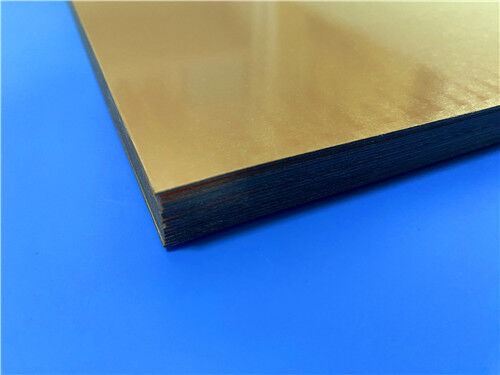
CuClad 233 laminates are woven fiberglass-reinforced PTFE composite materials engineered specifically for deployment as printed circuit board (PCB) substrates. Leveraging precise regulation of the fiberglass-to-PTFE ratio, CuClad 233 laminates provide a versatile product range—encompassing grades with ultra-low dielectric constant (Dk) and loss tangent, as well as highly reinforced variants optimized for enhanced dimensional stability.
The woven fiberglass reinforcement integral to CuClad series materials delivers superior dimensional stability compared to nonwoven fiberglass-reinforced PTFE laminates of equivalent dielectric constant. Rogers’ stringent process control and consistency over PTFE-coated fiberglass cloth not only enables a broader spectrum of available Dk values, but also yields laminates with improved dielectric constant uniformity relative to comparable nonwoven fiberglass-reinforced alternatives. These performance attributes position CuClad laminates as a high-value solution for RF filters, couplers, and low-noise amplifiers (LNAs).
A defining characteristic of CuClad 233 laminates is their cross-plied architecture: alternating layers of PTFE-coated fiberglass plies are oriented at 90° to one another. This design achieves true electrical and mechanical isotropy in the XY plane—a proprietary feature exclusive to CuClad 233 laminates that no other woven or nonwoven fiberglass-reinforced PTFE laminates can match. This exceptional level of isotropy is critical for demanding applications such as phased array antennas.
With a dielectric constant (Er) of 2.33, CuClad 233 employs a balanced fiberglass-to-PTFE ratio that optimizes low dielectric constant and improved dissipation factor, without compromising core mechanical performance.
![]()
Features & Benefits
Typical Applications
| Property | Test Method | Condition | CuClad 233 |
| Dielectric Constant @10 GHz | IPC TM-650 2.5.5.5 | C23/50 | 2.33 |
| Dielectric Constant @1MHz | IPC TM-650 2.5.5.3 | C23/50 | 2.33 |
| Dissipation Factor @10 GHz | IPC TM-650 2.5.5.5 | C23/50 | 0.0013 |
| Thermal Coefficient of Er (ppm/°C) | IPC TM-650 2.5.5.5 Adapted | -10°C to +140°C | -161 |
| Peel Strength (lbs.per inch) | IPC TM-650 2.4.8 | After Thermal Stress | 14 |
| Volume Resistivity (MΩ-cm) | IPC TM-650 2.5.17.1 | C96/35/90 | 8.0 x 10 8 |
| Surface Resistivity (MΩ) | IPC TM-650 2.5.17.1 | C96/35/90 | 2.4 x 10 6 |
| Arc Resistance (seconds) | ASTM D-495 | D48/50 | >180 |
| Tensile Modulus (kpsi) | ASTM D-638 | A, 23°C | 510, 414 |
| Tensile Strength (kpsi) | ASTM D-882 | A, 23°C | 10.3, 9.8 |
| Compressive Modulus (kpsi) | ASTM D-695 | A, 23°C | 276 |
| Flexural Modulus (kpsi) | ASTM D-790 | A, 23°C | 371 |
| Dielectric Breakdown (kv) | ASTM D-149 | D48/50 | > 45 |
| Specific Gravity (g/cm3) | ASTM D-792 Method A | A, 23°C | 2.26 |
| Water Absorption (%) | MIL-S-13949H 3.7.7 IPC TM-650 2.6.2.2 | E1/105 + D24/23 | 0.02 |
|
Coefficient of Thermal Expansion (ppm/°C) X Axis Y Axis Z Axis |
IPC TM-650 2.4.24 Mettler 3000 Thermomechanical Analyzer |
0°C to 100°C |
23 24 194 |
| Thermal Conductivity | ASTM E-1225 | 100°C | 0.26 |
|
Outgassing Total Mass Loss (%) Collected Volatile Condensable Material (%) Water Vapor Regain (%) Visible Condensate (±) |
NASA SP-R-0022A Maximum 1.00% Maximum 0.10% |
125°C, ≤ 10-6 torr |
0.01 0.01 0.00 NO |
| Flammability | UL 94 Vertical Burn IPC TM-650 2.3.10 | C48/23/50, E24/125 | Meets requirements of UL94-V0 |
![]()
| MOQ: | 1PCS |
| Price: | USD9.99-99.99 |
| Standard Packaging: | Vacuum bags+Cartons |
| Delivery Period: | 8-9 working days |
| Payment Method: | T/T |
| Supply Capacity: | 5000PCS per month |
CuClad 233 laminates are woven fiberglass-reinforced PTFE composite materials engineered specifically for deployment as printed circuit board (PCB) substrates. Leveraging precise regulation of the fiberglass-to-PTFE ratio, CuClad 233 laminates provide a versatile product range—encompassing grades with ultra-low dielectric constant (Dk) and loss tangent, as well as highly reinforced variants optimized for enhanced dimensional stability.
The woven fiberglass reinforcement integral to CuClad series materials delivers superior dimensional stability compared to nonwoven fiberglass-reinforced PTFE laminates of equivalent dielectric constant. Rogers’ stringent process control and consistency over PTFE-coated fiberglass cloth not only enables a broader spectrum of available Dk values, but also yields laminates with improved dielectric constant uniformity relative to comparable nonwoven fiberglass-reinforced alternatives. These performance attributes position CuClad laminates as a high-value solution for RF filters, couplers, and low-noise amplifiers (LNAs).
A defining characteristic of CuClad 233 laminates is their cross-plied architecture: alternating layers of PTFE-coated fiberglass plies are oriented at 90° to one another. This design achieves true electrical and mechanical isotropy in the XY plane—a proprietary feature exclusive to CuClad 233 laminates that no other woven or nonwoven fiberglass-reinforced PTFE laminates can match. This exceptional level of isotropy is critical for demanding applications such as phased array antennas.
With a dielectric constant (Er) of 2.33, CuClad 233 employs a balanced fiberglass-to-PTFE ratio that optimizes low dielectric constant and improved dissipation factor, without compromising core mechanical performance.
![]()
Features & Benefits
Typical Applications
| Property | Test Method | Condition | CuClad 233 |
| Dielectric Constant @10 GHz | IPC TM-650 2.5.5.5 | C23/50 | 2.33 |
| Dielectric Constant @1MHz | IPC TM-650 2.5.5.3 | C23/50 | 2.33 |
| Dissipation Factor @10 GHz | IPC TM-650 2.5.5.5 | C23/50 | 0.0013 |
| Thermal Coefficient of Er (ppm/°C) | IPC TM-650 2.5.5.5 Adapted | -10°C to +140°C | -161 |
| Peel Strength (lbs.per inch) | IPC TM-650 2.4.8 | After Thermal Stress | 14 |
| Volume Resistivity (MΩ-cm) | IPC TM-650 2.5.17.1 | C96/35/90 | 8.0 x 10 8 |
| Surface Resistivity (MΩ) | IPC TM-650 2.5.17.1 | C96/35/90 | 2.4 x 10 6 |
| Arc Resistance (seconds) | ASTM D-495 | D48/50 | >180 |
| Tensile Modulus (kpsi) | ASTM D-638 | A, 23°C | 510, 414 |
| Tensile Strength (kpsi) | ASTM D-882 | A, 23°C | 10.3, 9.8 |
| Compressive Modulus (kpsi) | ASTM D-695 | A, 23°C | 276 |
| Flexural Modulus (kpsi) | ASTM D-790 | A, 23°C | 371 |
| Dielectric Breakdown (kv) | ASTM D-149 | D48/50 | > 45 |
| Specific Gravity (g/cm3) | ASTM D-792 Method A | A, 23°C | 2.26 |
| Water Absorption (%) | MIL-S-13949H 3.7.7 IPC TM-650 2.6.2.2 | E1/105 + D24/23 | 0.02 |
|
Coefficient of Thermal Expansion (ppm/°C) X Axis Y Axis Z Axis |
IPC TM-650 2.4.24 Mettler 3000 Thermomechanical Analyzer |
0°C to 100°C |
23 24 194 |
| Thermal Conductivity | ASTM E-1225 | 100°C | 0.26 |
|
Outgassing Total Mass Loss (%) Collected Volatile Condensable Material (%) Water Vapor Regain (%) Visible Condensate (±) |
NASA SP-R-0022A Maximum 1.00% Maximum 0.10% |
125°C, ≤ 10-6 torr |
0.01 0.01 0.00 NO |
| Flammability | UL 94 Vertical Burn IPC TM-650 2.3.10 | C48/23/50, E24/125 | Meets requirements of UL94-V0 |
![]()