logo
Products
PRODUCTS DETAILS
Home > Products >
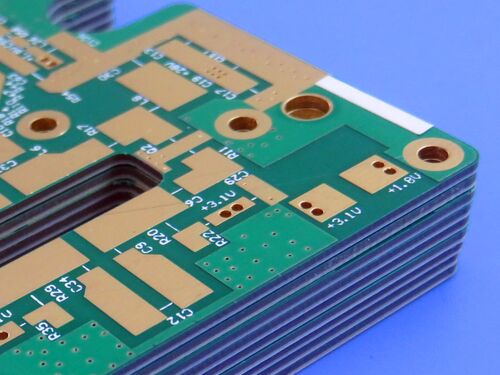
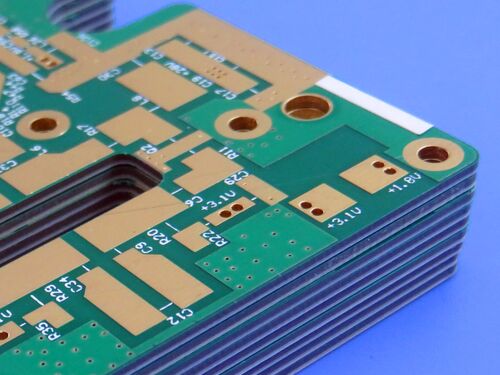
4-layer Hybrid PCB on RT duroid 5880 and FR4 material ENIG Finish

4-layer Hybrid PCB on RT duroid 5880 and FR4 material ENIG Finish

MOQ: 1PCS
Price: USD9.99-99.99
Standard Packaging: Vacuum bags+Cartons
Delivery Period: 8-9 working days
Payment Method: T/T
Supply Capacity: 5000PCS per month
Detail Information
Place of Origin
CHINA
Brand Name
Bicheng
Certification
UL, ISO9001, IATF16949
Model Number
BIC-200.V1.0
Base Material:
1.575mm RT/duroid 5880 + PP + 0.5mm High Tg 170°C FR-4
Layer Count:
3 Copper Layers
PCB Thickness:
2.3mm (after Lamination)
PCB Size:
74mm × 101mm Per Piece
Copper Weight:
Outer Layers: 1oz; Inner Layer: 0.5oz Finished Copper
Surface Finish:
Immersion Gold (ENIG)
Highlight:

4-layer hybrid RF PCB

,

RT duroid 5880 PCB board

,

FR4 material ENIG finish PCB

Product Description

This PCB uses RT duroid 5880 high-frequency laminates integrated with High Tg 170°C FR-4 as its material, delivering superior high-frequency signal integrity. It is furnished with an Immersion Gold (ENIG) surface finish and adopts a double-sided configuration free of solder mask and silkscreen. Backed by precise dimensional control and stringent quality assurance protocols, this PCB is specifically engineered to meet the rigorous performance requirements of high-reliability electronic applications.


PCB Details

Construction Parameter Specification
Base material 1.575mm RT/duroid 5880 + PP + 0.5mm High Tg 170°C FR-4
Layer count 3 copper layers
Board dimensions 74mm × 101mm per piece
Finished board thickness 2.3mm (after lamination)
Finished Cu weight Outer layers: 1oz; Inner layer: 0.5oz finished copper
Surface finish Immersion Gold (ENIG)
Solder Mask & Silkscreen Double-sided: No solder mask (oil-free) and no silkscreen (word-free)
Special Feature Step-shaped outline (stepped profile)
Quality test 100% Electrical test conducted prior to shipment


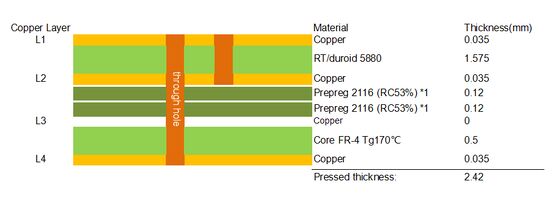
PCB Stack-up

Layer Type Specification (From Top to Bottom)
Copper Layer Copper_layer_1: 1oz (35μm)
Dielectric Layer RT/duroid 5880: 1.575mm
Copper Layer Copper_layer_2: 0.5oz (17.5μm)
Prepreg Layer (PP) Standard PP (matching material system) - Layer 1
Prepreg Layer (PP) Standard PP (matching material system) - Layer 2
Core Layer High Tg 170°C FR-4: 0.5mm
Copper Layer Copper_layer_4: 1oz (35μm)


4-layer Hybrid PCB on RT duroid 5880 and FR4 material ENIG Finish 0


Artwork Type

To ensure accurate and efficient PCB manufacturing, the artwork supplied for this PCB is in Gerber RS-274-X format, which is the industry-standard file format for PCB fabrication.


Quality Standard

This PCB is manufactured and inspected in strict compliance with the IPC-Class-2 standard, a widely adopted industry standard for printed circuit boards. IPC-Class-2 specifies requirements for general electronic products, ensuring reliable performance in typical applications.


Availability

This PCB is offered globally, with a stable supply capability to accommodate diverse order requirements—ranging from small-batch prototypes to large-scale mass production—backed by efficient logistics solutions to ensure timely global delivery.


Introduction to RT/duroid 5880 Material

RT/duroid 5880 is a high-performance polytetrafluoroethylene (PTFE)-based composite dielectric material developed by Rogers Corporation, specifically engineered for high-frequency, low-loss electronic applications. It features a woven glass reinforcement structure, combining the excellent electrical properties of PTFE with enhanced mechanical robustness, making it suitable for precision high-frequency PCB fabrication.


RT/duroid 5880 laminates offer tight control over dielectric constant (Dk) and maintain ultra-low loss, available at a reasonable cost compared to conventional microwave laminates. Unlike PTFE-based materials, RT/duroid 5880 does not require special through-hole treatments or handling procedures, simplifying manufacturing processes. These materials are UL 94 V-0 rated, making them suitable for active devices and high-power RF designs.


The thermal coefficient of expansion (CTE) of RT/duroid 5880 material provides several key benefits to circuit designers. Its expansion coefficient is well-matched to copper, ensuring excellent dimensional stability—a critical property for multi-layer board constructions. The optimized Z-axis CTE of RT/duroid 5880 laminates ensures reliable plated through-hole quality, even in severe thermal shock applications. As a PTFE-based material, it has no distinct glass transition temperature (Tg), maintaining stable expansion characteristics over the entire range of circuit processing temperatures.


4-layer Hybrid PCB on RT duroid 5880 and FR4 material ENIG Finish 1


Features of RT/duroid 5880 Material

Material Property Specification
Dielectric Constant (Dk) 2.20 ± 0.02 at 10GHz/23°C
Dissipation Factor (Df) 0.0009 at 10GHz/23°C
Thermal Conductivity 0.29 W/m·°K
Coefficient of Thermal Expansion (CTE) X: 12 ppm/°C; Y: 14 ppm/°C; Z: 210 ppm/°C
Glass Transition Temperature (Tg) None (PTFE-based material, no distinct Tg)
Water Absorption (24h) 0.01%
Flammability Rating UL 94 V-0


Typical Applications


-Microwave and millimeter-wave communication systems (up to 60GHz)


-Radar and satellite communication equipment


-RF power amplifiers and filters


-Aerospace and defense electronic systems


-Test and measurement instruments for high-frequency applications


-5G millimeter-wave base stations and terminal devices


Summary

With ultra-low signal loss, excellent dimensional stability and reliable structural performance, this 3-copper-layer PCB is an ideal solution for engineers, electronic product manufacturers and RF system integrators pursuing high reliability and stable high-frequency signal transmission. It effectively meets the high-performance requirements of high-frequency applications including microwave communication, radar systems, aerospace electronic equipment and 5G millimeter-wave devices.


What is Hybrid PCB?

A Hybrid PCB (Hybrid Printed Circuit Board) refers to a specialized PCB that integrates two or more different types of dielectric materials in its structure, rather than using a single uniform material. The core purpose of designing hybrid PCBs is to balance performance, cost, and functional requirements—leveraging the unique advantages of each material to optimize the overall performance of the circuit board.


In practical applications, hybrid PCBs often combine high-performance, high-cost dielectric materials (such as RT/duroid 5880) with cost-effective, structurally robust materials (such as High Tg 170°C FR-4). For example, the PCB specified in this document adopts a hybrid structure of RT/duroid 5880 (for high-frequency, low-loss signal transmission) and High Tg 170°C FR-4 (for structural support and cost control), which is a typical example of a hybrid PCB.


Key characteristics and advantages of hybrid PCBs:

Performance Optimization: Tailor material selection for different functional areas (e.g., high-frequency signal layers use low-Dk/Df materials, while structural layers use high-strength materials).


-Cost-Effectiveness: Reduce overall costs by using high-performance materials only in critical areas, instead of the entire board.


-Functional Versatility: Meet diverse requirements such as high-frequency transmission, mechanical robustness, and thermal management in a single PCB.


-Application Adaptability: Widely used in complex electronic systems such as aerospace, communication, and medical equipment, where multiple performance requirements need to be met simultaneously.

 

4-layer Hybrid PCB on RT duroid 5880 and FR4 material ENIG Finish 2

Products
PRODUCTS DETAILS
4-layer Hybrid PCB on RT duroid 5880 and FR4 material ENIG Finish
MOQ: 1PCS
Price: USD9.99-99.99
Standard Packaging: Vacuum bags+Cartons
Delivery Period: 8-9 working days
Payment Method: T/T
Supply Capacity: 5000PCS per month
Detail Information
Place of Origin
CHINA
Brand Name
Bicheng
Certification
UL, ISO9001, IATF16949
Model Number
BIC-200.V1.0
Base Material:
1.575mm RT/duroid 5880 + PP + 0.5mm High Tg 170°C FR-4
Layer Count:
3 Copper Layers
PCB Thickness:
2.3mm (after Lamination)
PCB Size:
74mm × 101mm Per Piece
Copper Weight:
Outer Layers: 1oz; Inner Layer: 0.5oz Finished Copper
Surface Finish:
Immersion Gold (ENIG)
Minimum Order Quantity:
1PCS
Price:
USD9.99-99.99
Packaging Details:
Vacuum bags+Cartons
Delivery Time:
8-9 working days
Payment Terms:
T/T
Supply Ability:
5000PCS per month
Highlight

4-layer hybrid RF PCB

,

RT duroid 5880 PCB board

,

FR4 material ENIG finish PCB

Product Description

This PCB uses RT duroid 5880 high-frequency laminates integrated with High Tg 170°C FR-4 as its material, delivering superior high-frequency signal integrity. It is furnished with an Immersion Gold (ENIG) surface finish and adopts a double-sided configuration free of solder mask and silkscreen. Backed by precise dimensional control and stringent quality assurance protocols, this PCB is specifically engineered to meet the rigorous performance requirements of high-reliability electronic applications.


PCB Details

Construction Parameter Specification
Base material 1.575mm RT/duroid 5880 + PP + 0.5mm High Tg 170°C FR-4
Layer count 3 copper layers
Board dimensions 74mm × 101mm per piece
Finished board thickness 2.3mm (after lamination)
Finished Cu weight Outer layers: 1oz; Inner layer: 0.5oz finished copper
Surface finish Immersion Gold (ENIG)
Solder Mask & Silkscreen Double-sided: No solder mask (oil-free) and no silkscreen (word-free)
Special Feature Step-shaped outline (stepped profile)
Quality test 100% Electrical test conducted prior to shipment


PCB Stack-up

Layer Type Specification (From Top to Bottom)
Copper Layer Copper_layer_1: 1oz (35μm)
Dielectric Layer RT/duroid 5880: 1.575mm
Copper Layer Copper_layer_2: 0.5oz (17.5μm)
Prepreg Layer (PP) Standard PP (matching material system) - Layer 1
Prepreg Layer (PP) Standard PP (matching material system) - Layer 2
Core Layer High Tg 170°C FR-4: 0.5mm
Copper Layer Copper_layer_4: 1oz (35μm)


4-layer Hybrid PCB on RT duroid 5880 and FR4 material ENIG Finish 0


Artwork Type

To ensure accurate and efficient PCB manufacturing, the artwork supplied for this PCB is in Gerber RS-274-X format, which is the industry-standard file format for PCB fabrication.


Quality Standard

This PCB is manufactured and inspected in strict compliance with the IPC-Class-2 standard, a widely adopted industry standard for printed circuit boards. IPC-Class-2 specifies requirements for general electronic products, ensuring reliable performance in typical applications.


Availability

This PCB is offered globally, with a stable supply capability to accommodate diverse order requirements—ranging from small-batch prototypes to large-scale mass production—backed by efficient logistics solutions to ensure timely global delivery.


Introduction to RT/duroid 5880 Material

RT/duroid 5880 is a high-performance polytetrafluoroethylene (PTFE)-based composite dielectric material developed by Rogers Corporation, specifically engineered for high-frequency, low-loss electronic applications. It features a woven glass reinforcement structure, combining the excellent electrical properties of PTFE with enhanced mechanical robustness, making it suitable for precision high-frequency PCB fabrication.


RT/duroid 5880 laminates offer tight control over dielectric constant (Dk) and maintain ultra-low loss, available at a reasonable cost compared to conventional microwave laminates. Unlike PTFE-based materials, RT/duroid 5880 does not require special through-hole treatments or handling procedures, simplifying manufacturing processes. These materials are UL 94 V-0 rated, making them suitable for active devices and high-power RF designs.


The thermal coefficient of expansion (CTE) of RT/duroid 5880 material provides several key benefits to circuit designers. Its expansion coefficient is well-matched to copper, ensuring excellent dimensional stability—a critical property for multi-layer board constructions. The optimized Z-axis CTE of RT/duroid 5880 laminates ensures reliable plated through-hole quality, even in severe thermal shock applications. As a PTFE-based material, it has no distinct glass transition temperature (Tg), maintaining stable expansion characteristics over the entire range of circuit processing temperatures.


4-layer Hybrid PCB on RT duroid 5880 and FR4 material ENIG Finish 1


Features of RT/duroid 5880 Material

Material Property Specification
Dielectric Constant (Dk) 2.20 ± 0.02 at 10GHz/23°C
Dissipation Factor (Df) 0.0009 at 10GHz/23°C
Thermal Conductivity 0.29 W/m·°K
Coefficient of Thermal Expansion (CTE) X: 12 ppm/°C; Y: 14 ppm/°C; Z: 210 ppm/°C
Glass Transition Temperature (Tg) None (PTFE-based material, no distinct Tg)
Water Absorption (24h) 0.01%
Flammability Rating UL 94 V-0


Typical Applications


-Microwave and millimeter-wave communication systems (up to 60GHz)


-Radar and satellite communication equipment


-RF power amplifiers and filters


-Aerospace and defense electronic systems


-Test and measurement instruments for high-frequency applications


-5G millimeter-wave base stations and terminal devices


Summary

With ultra-low signal loss, excellent dimensional stability and reliable structural performance, this 3-copper-layer PCB is an ideal solution for engineers, electronic product manufacturers and RF system integrators pursuing high reliability and stable high-frequency signal transmission. It effectively meets the high-performance requirements of high-frequency applications including microwave communication, radar systems, aerospace electronic equipment and 5G millimeter-wave devices.


What is Hybrid PCB?

A Hybrid PCB (Hybrid Printed Circuit Board) refers to a specialized PCB that integrates two or more different types of dielectric materials in its structure, rather than using a single uniform material. The core purpose of designing hybrid PCBs is to balance performance, cost, and functional requirements—leveraging the unique advantages of each material to optimize the overall performance of the circuit board.


In practical applications, hybrid PCBs often combine high-performance, high-cost dielectric materials (such as RT/duroid 5880) with cost-effective, structurally robust materials (such as High Tg 170°C FR-4). For example, the PCB specified in this document adopts a hybrid structure of RT/duroid 5880 (for high-frequency, low-loss signal transmission) and High Tg 170°C FR-4 (for structural support and cost control), which is a typical example of a hybrid PCB.


Key characteristics and advantages of hybrid PCBs:

Performance Optimization: Tailor material selection for different functional areas (e.g., high-frequency signal layers use low-Dk/Df materials, while structural layers use high-strength materials).


-Cost-Effectiveness: Reduce overall costs by using high-performance materials only in critical areas, instead of the entire board.


-Functional Versatility: Meet diverse requirements such as high-frequency transmission, mechanical robustness, and thermal management in a single PCB.


-Application Adaptability: Widely used in complex electronic systems such as aerospace, communication, and medical equipment, where multiple performance requirements need to be met simultaneously.


4-layer Hybrid PCB on RT duroid 5880 and FR4 material ENIG Finish 2

Sitemap |  Privacy Policy | China Good Quality RF PCB Board Supplier. Copyright © 2020-2026 Bicheng Electronics Technology Co., Ltd . All Rights Reserved.